
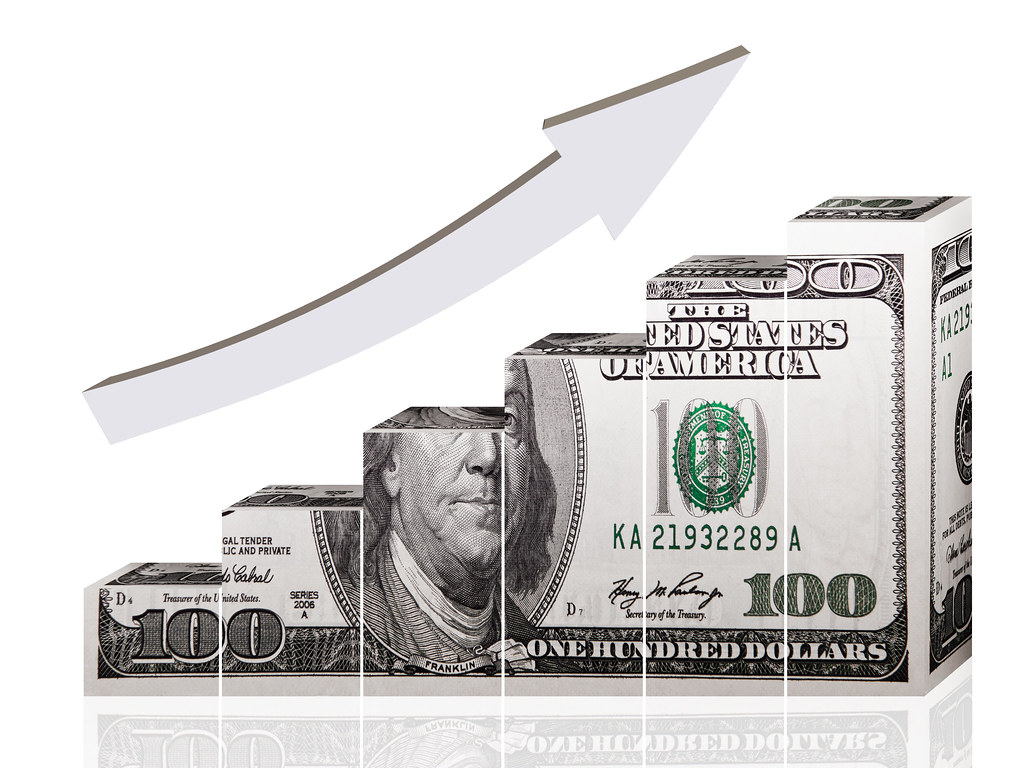
Compound interest is very powerful. When it’s working for you, it will cause your money to grow exponentially over time. If compound interest is working against you, it can bury you in overwhelming debt over time. With compound interest, you are gaining not only interest on the original investment, but also on previous interest. This “interest on interest” is what be a powerful investment tool when used correctly. When used incorrectly, this can lead to financial ruin. Let’s take a look.
Compounding Interest On Interest
“Money makes money.” Benjamin Franklin once said “[a]nd the money that makes money makes more money.” Given enough time with compound interest your money will make more money, money that you didn’t have to work for, and that money will continue on to make more money.
The ways that interest can compound are almost unlimited. Annually, semi-annually (bi-annually), quarterly, and monthly, are some of the most common periods. Daily compounded interest is a common thing on some credit cards. Make sure that you read the fine print before signing up for a high interest daily compounded credit card.
The Good
Compound interest is the process of money making money (or debt making debt). More accurately, it is interest on interest on interest. This process start slowly at first but grows exponentially. If you recall, Simple interest only calculates on the principal amount. With simple interest, if you invested $100 at 10% interest for 2 years, at the end of the 2 years you would have $120. However, with compound interest you would have $121 instead. Why?
Simple interest calculates on the principal amount, or the original amount borrowed, only: $100 in the example above. Compound interest is calculated using the principal balance: the principal plus any interest earned. In the above example, at the end of the first year, you have $110. The second year you have $121 since you also eared 10% interest on the previous $10, or $1, in interest on interest. Now, I am using small numbers to show how things work, but it is the same using $100 and $100,000,000.
Calculating Compound Interest
The standard formula for compound interest is A = P(1 + r/n)nt
Holy cow, that’s some scary stuff! Well, going back to simple interest and the order of operations, you see this isn’t bad. This is a formula I use all the time. Breaking down each piece we get this
A = Amount – this is the total at the end of the compounding (total value)
P = Principal – the amount invested
r = Interest Rate
n = Number of times interest is compounded per year
t = Number of years to compound
Recall from simple interest that the formula was PIT, where I = Interest Rate. Interest is commonly denoted as r which would look like Prt for simple interest. So the base formula is almost identical; however, we have to account for compounding intervals (n) over time (t) and a changing principal balance. This is why simple interest is so important to understand first.
Plugging in the numbers from the above example:

*Remember that exponents are basically multiplying the value the number of times specified. 1.12 becomes 1.1 * 1.1. Which is to multiply 1.1 by 110% 10% more: 1.1 + .11 = 1.21.
Let’s take $10,000 and calculate what we would have at the end of 5 years with 8% interest compounded monthly. Follow your order of operations

Not bad for not having to work for a single cent of that. The beauty of this is that it will continue to compound, earning more each time. This is a real life example an investment I currently own. This assumes, however, that I never invest anymore during those 5 years. That is not the case. There is a way to calculate compound interest with monthly contributions and the results are shocking. In the above example, if I continue to contribute just $200 every month for those 5 years, I would end up with $29,593.83 instead of $14,898.46. That is almost double and that’s the power of compound interest.
This simply shows you the total amount of interest that you will receive on an investment over a period of time. To see the interest that you will get per period you need to calculate the interest accrual schedule.
The Bad
The bad part: compound interest works the same way with debt. Money that you borrow generally has an interest rate and compounds regularly. If payments are missed, or interest is left unpaid after your payment has been applied, then the unpaid interest is added to your principal balance and then interest on interest begins.
This happens often with credit cards that have notoriously high interest rates. Some have as high as 36%. Student loans are also deceivingly devious in this area. It sounds great when you get a loan for a relatively low interest rate. Better yet, you get the student loan and it goes into deferment while you are in school and then you have a grace period after graduation (if you complete your degree). All the while, the unsubsidized loans are accruing interest which is then capitalized into the principal balance to generate more interest. The worst part, student loans can have 1 – 10 years of compounding head start on you before you begin paying.
Let’s take a look at a credit card balance of $1,000 with an interest rate of 32.99% (that is not a typo):

Ouch! Almost $400 in interest on a $1,000 balance if you only paid interest. Why would you only pay interest? Some times you can only make the minimum payments and sometimes those minimums don’t even cover the interest for that billing cycle. Don’t get in this situation in the first place.
Here’s another example of a common use of credit cards: family vacation. $7,249 was the average cost of a vacation in the USA — even more for international — for 2025 according to The Motley Fool. If you charge all of that on a credit card the interest can add up quick. Let’s assume a 26.24% interest rate for 1 year (actual interest rate from one of my cards).

That’s $2,148.43 in interest in a single year. This is roughly $180 a month in interest alone. If the minimum payment due is $150, then $30 of unpaid interest would start to generate interest on interest. Compound interest working against you.
The last example is going to be the amount of interest on a student loan. This example shows how much interest is applied to your loan while in a “grace period” before you are required to defer longer or begin payments.
Let’s assume a Bachelor’s degree is earned in the average of 6 years. The student took out the maximum $12,500 at 6.39% for their unsubsidized student loans for their first year and didn’t begin repayment until after their 4 year grace period after graduation expires.

The interest alone is roughly $125 a month. That doesn’t sound so bad, right? Do the math and see that over the course of 20 years paying $125 on this before student loan forgiveness can be applied, you’ll pay $30,240 and still have a balance of $23,590.
Compound interest is a powerful ally or a monstrous enemy in finance. Time is the most important part of compounding and most people neglect the time element. In order for this tool to reach its fullest potential, you should invest early and invest for life.